Parry the blow, my friends
Helen DeWitt's The Last Samurai was made for these times
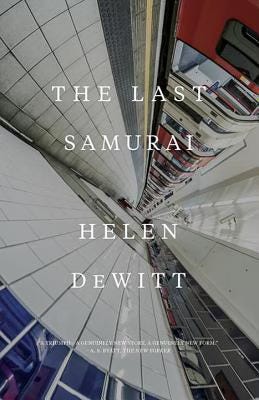
I’ve been reading The Last Samurai by Helen DeWitt while sipping from my Things-Could-Be-Worse mug. Oh, and preparing my shelves for the apocalypse. Read on to find out how these things are related.
The Last Samurai
Sybilla comes from a line of geniuses the world failed to recognize. She leaves Oxford, disillusioned with academia, but refuses to return to America under Reagan. She has a “Cat Person”-like one-night stand with a mediocre writer she code names Liberace, for his tacky sexual showmanship. She decides to raise the resulting son, Ludo, alone. She surrounds him with books, not just in English, but also in Greek, Arabic, Hebrew and Japanese. Ludo rises to the challenge. In between answering his many questions, Sybilla eeks out an existence as a typist from their flat. The two spend their days circling London on The Tube, trying to stay warm. At home, Sybilla watches The Seven Samurai compulsively, rationalizing it as a way to give Ludo some positive male role models.
By age 11, Ludo is studying aerodynamics and solid-state physics. But he’s fixated on a simpler question: the identity of his father. It becomes his obsession, and he sets out to find a suitable father figure among the newsworthy men of Cambridge and London—someone who can “parry the blow” like a samurai.
The novel's charm lies in Ludo’s perspective. It’s not just his genius that’s captivating. It’s his relatable search for an elusive combination of security and freedom. The Last Samurai isn’t just about a boy and his mother. It’s about figuring out how to live in a world where survival requires something baser than what you’re capable of.
It’s about finding ways to play, even when everything around you feels like it's falling apart. And it’s about how repetition and fragmentation produce sudden breakthroughs, if only we can hang on through the cycles.
There’s a breakthrough like this in the book—a concert scene that moves Sybilla to tears. She expects to hear the same familiar pieces again, but they’re rearranged, played only once, perhaps imperfectly. It’s a reminder: there’s no second chance at life. The moment passes, and with it, everything that came before. Quoted from the scene:
You expected to hear Op. 10 No. 1 in D minor for the 60th time, but instead were shocked to hear in quick succession Op. 10 No. 2 in D major, Op. 10 No. 3 in B minor and Op. 10 No. 4 in B major, and you only heard them once each. It was as if after the illusion that you could have a thing 500 ways without giving up one he said No, there is only one chance at life once it is gone it is gone for good you must seize the moment before it goes, tears were streaming down my face as I heard these three pieces each with just one chance of being heard if there was a mistake then the piece was played just once with a mistake if there was some other way to play the piece you heard what you heard and it was time to go home.
Mostly though, it’s about facing reality without submitting to it as the end of possibility. I found it witty and touching in an unsentimental, post-modern way— and absolutely deserving of its spot among the top 30 in NYT’s list of the 100 best books published in English this century.
If you’ve ever wanted to read The Last Samurai, now’s the time. Trust me.
Reading at the right time
In 2019, I Marie Kondo-ed most of my books. Fifty feet of them—gone. These were books I’d been collecting for decades, since my days as a literature major. They’d followed me through eight homes and four cities, including Santiago, Chile. Each time I moved, more boxes moved with me. But in 2019, I looked at them and realized they were stagnant. Doing me no good.
I’ve never been too precious about books. I lend them out without expecting them back. I don’t often re-read. Between grad school and the recession, I traded lots of my books in used bookstores just to stretch my budget. So my collection wasn’t a record of everything I’d read. But it was a reflection of all the choices I’d made to narrow the possibilities of who I could become, in favor of who I’d actually be.
But when it came time to move again, I noticed the how the chipboard shelves were sagging. The books dusty with lack of attention. Nothing about them “sparked joy.”
The pitiable state of my shelves was a symptom of a shift in my reading habits after the 2016 election. News felt more urgent, more immediate, than books. I couldn’t focus on fiction anymore. By 2019 I felt too numb and exhausted, from the rhetoric, from the erosion of rights, and from simultaneously experiencing more scapegoating and exclusion and outright aggression toward women in my workplace than I’d ever seen before, to make it through many books at all.
So, I purged. I kept only the out-of-print books. The hard-to-find ones. I donated the rest. I told myself I could always borrow what I needed from the library.
But I kept The Last Samurai. I’d read about Helen DeWitt’s struggles to get the book published, how she had fought to keep it in print and how broke she was. I’d read about her time at Smith College (my alma mater), which she hated. Something about it stuck with me. I knew I would read it eventually.
Now, having finally read it and closed the loop on this cycle, I don’t regret getting rid of my books when I did. When I feel sad about the ones I let go, I make a short list of the titles I wish I still had. I’ve started finding them, one by one, adding them back to my shelves. Letting go made room to choose my identity as a book lover intentionally again.
Last month, I noticed the return of an ache in my hands I associate with scrolling like a fiend. This time, I knew what had to be done. A mini-purge: 46 books left my shelves. I donated most of them, and got some trade credit for the rest. But in exchange, I added 13 new-to-me books to my collection. Enough to last through an emergency convalescence (not that I have one planned!). And to spark some new ideas for curated lists on The Booktender. This time, I’m holding on to my joy.
This isn’t some “books will unite us” bullshit message. I’m still angry. I’m still processing everything that’s happening. But I hope whatever brings you joy, you can surround yourself with what you need to access it.
Two readers of The Booktender told me they’re also doubling down on reading after the election. One wants to strengthen her mind and heart to against despair. The other is studying authoritarianism, preparing for what she sees coming. If reading is part of how you’re getting through, you’re not alone here.
In case you missed it
Another recent review of The Last Samurai. It seems to be having a Substack moment.
From Woman of Letters Naomi Kanakia:
What is a TBR for, anyway? From Alexander Chee:
Up next
I’ve been reading The Molino from my November list and it’s gorgeous. And I’m going to start Margo’s Got Money Troubles this week, too.
Plus I’m excited to share the story of some local bookish friends who have combined their love of reading and acts of kindness to create an amazing boost for our community here in Tucson. Stay tuned for some more book joy.
So tell me…
Do you lend out your books and expect them back? How’s that going for you?
How do you know when it’s time to purge your books?
If you could be a genius in one subject (or if you ARE a genius), which would it be?


Thank you! I love that novel so much.
I have become very particular about purchasing physical books, so the ones I own, I consider keepsakes and irreplaceable, So I am not an easy lender - I have to really trust I will get it back in the same shape. I am, however, an excellent book gifter. If a book speaks to me and I want to share it with someone, I just send them a copy.
Purging books happens every summer and is mainly focused on the kids and they take part in it. I have a much easier time gifting to friends that I know will be thankful and enjoy than taking to somewhere like goodwill or the resale store - but the kids like that because they can earn money for more books.
I honestly don’t know if I would like to be a genius on any one subject. I’d like to know everything about certain random things but that isn’t the same - I’ll have to think on it!