

why we can't have nice things
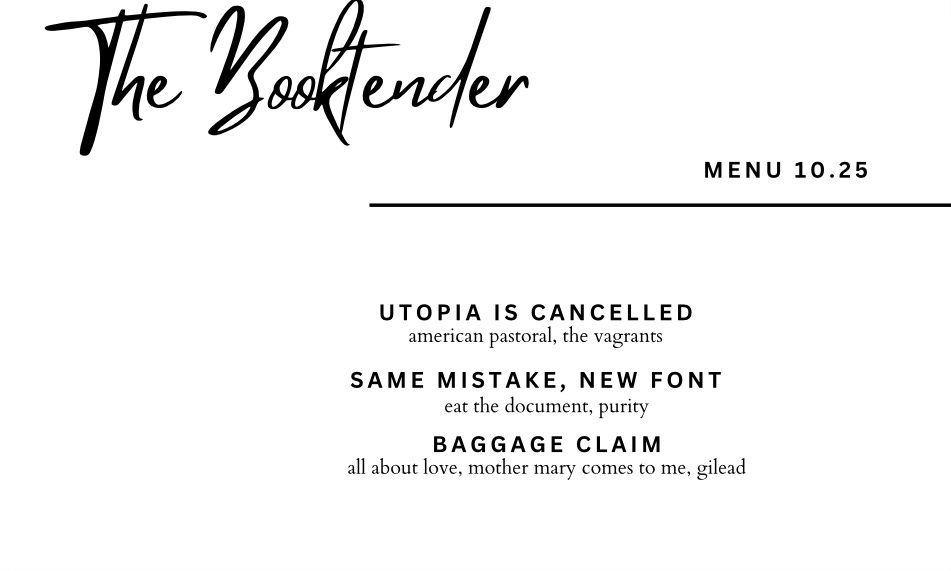
menu 10.25 reading about inheritance and dissent

American berserk
In September, I re-read a book I thought I hated.
The character at the center of American Pastoral by Philip Roth, Seymour ‘Swede’ Levov, is an assimilated third-generation American from a Jewish family, a self-made glove factory owner living in the hills near a WASPy village outside of Newark, New Jersey with his Miss America candidate wife. In a scene that made me laugh out loud, one Saturday morning he skips home from the village post office, acting out his identification with his hero Johnny Appleseed, throwing his arms around as though tossing seeds from a bag at his waist. He loves his life!
It’s the 1960s, and unrest will soon disturb this idyll as his teenage daughter Merry sets off a bomb at that same post office in protest of the Vietnam war. But for that moment, he believes that his intentions and the intentions of the people around him are so good, all they need to do is to keep being responsible, volunteering for committees, voting for the leaders on the side of prosperity and peace and dancing through meadows, confident things will keep getting better.
When I first tried to read this book in 1997, I found it so vile in the first 100 pages that I didn’t make it as far as that satirical scene—let alone to the battle scene of a dinner party that concludes the novel, where it becomes apparent that there’s no real lesson here for the Swede, as imagined by the impotent writer and Swede’s high school classmate, Nathan Zuckerman: he is incorrigibly certain of the morality of his way of life and of the myth that America’s democratic meritocracy is a kind of paradise. I thought at the time that American Pastoral was asking me to accept a worldview in which the role of women and black people and gays and youth and all of those who run counter to the vein of patriarchal intergenerational progress is to wait patiently for history to happen. As though to expect something else was the equivalent of being a killer. How passé.
On being wrong
In a passage I copied into my commonplace notebook, Zuckerman insists:
“The fact remains that getting people right is not what living is all about anyway. It’s getting them wrong that is living, getting them wrong and wrong and wrong and then, on careful reconsideration, getting them wrong again. That’s how we know we’re alive: we’re wrong.”
This time around, I found American Pastoral fascinating, in the way it juxtaposes an early 1970s fervor with the nonchalance of the late 1990s. There’s something very proto-Trump about a story centering a man who represses the rift within his own family and society and just starts over as though it never happened. Roth himself was not a Trump supporter, and he was just as adamant that none of his fiction was meant to serve a political message, that American political reality was far more impossibly ludicrous than any novelist could dream. Yet only a novel that so perceptively observed the political context of the second half of the 20th century could be decipherable in this way nearly 30 years later.
When I read it again, closer in age to Swede himself than his radical daughter, I found a meaning in American Pastoral exactly opposed to what I had once understood it to say. I felt it calling me to notice the fragility of American democracy, to reject any fantasy of its purity or other misplaced moralism, and to pay close attention to how quickly democracy can dissolve into extremism. To question my own callow fantasies of progress without violence or suffering.
What now?
These are unexpected times and honestly I’m unsure what my generation is meant to do about it.
Of course there are things to do, and individual people are doing them. But the toolkit feels ill-equipped for the scale of the breakdown. And more than half our peers voted for this mess, after all.
Like the Swede, I am finding it an odd experience to reach a comfortable middle age and believe I know who I am and to love my life, just as the world begins to go fully berserk. Well, really, who are you going to be now?
You know this stereotype: Gen X in the U.S. grew up skeptical of institutions, allergic to gullibility, fluent in detachment. What I think people sometimes miss about our supposed cynicism is that it was all based on the very 1990s assumption that once we were in charge of this liberal democracy, we’d work the rest out. But irony offers little guidance when democracy itself begins to wobble. What does resistance look like now for those of us whose youthful rebellion mostly consisted of shrugging at our elders’ earnest misbeliefs?
A reading list inspired by this quandary
This month’s reading list attempts to locate an underused muscle: the one that turns values into action.
Another bit of Zuckerman wisdom: “People think of history in the long term, but history, in fact, is a very sudden thing.” This is certainly true for the protagonists of these books, whose actions in a particular moment change their own trajectory and the trajectory of their communities.
Taking action might not require us to disappear into a radical cell or set things on fire, though many of the characters in the novels on this list do just that, or worse. They blow up buildings, abandon families, commit to causes that demand everything and justify anything. These books are not a blueprint. What draws me in is the way they explore the moment before the leap—and the long echo after. They linger in the aftermath, in the lives shaped or shattered by earlier convictions.
Some of these books feature a reckoning in midlife with what their protagonists once believed; others make sense of what their parents or predecessors did in the name of justice. That intergenerational reckoning feels important right now. How do we sort out inherited damage from our own responsibilities— before our own kids write memoirs explaining exactly how we blew it?
These books don’t offer answers. But they sit inside the tension between principle and fallout, between idealism and fatigue, between generations trying, failing, and refusing to carry on as expected. That’s the territory I want to live in this month.

Mother Mary Comes To Me, Arundhati Roy (2025)
This has been in my ears during my commute and at the gym all week, and it’s so shockingly good. Roy herself reads this memoir of growing up with her “gangster” of a mother, a feminist activist whose Supreme Court case overturned the inheritance laws that kept Indian women from their share of family property; a woman who left her husband and was subsequently shunned by her family and community— but who rose from those ashes to create a school attended by the children of privileged classes. Roy admires her for her fighting spirit but Mrs. Roy, as she’s called throughout, also turned her rage on her daughter with singular cruelty that left deep impressions on the author’s psyche. I’m at the point where Roy says enough to the abuse and becomes estranged from Mrs. Roy, starting her writing career and her own trajectory of political activism—and I’m actually looking forward to housekeeping as an excuse to binge the next chapters.

Purity, Jonathan Franzen (2015)
In this novel by the ultimate chronicler of highly-educated, white Gen X disillusionment, Pip Tyler, real name Purity, has had enough of her reclusive mother’s refusal to identify her father or tell her anything about her family history. Recently graduated and eager to get some kind of start on managing significant student loan debt, Pip’s recruited by a German activist to join a Wiki-leaks style organization based in Bolivia. Its leader, Andreas Wolf, has a checkered Cold War past. When she returns to the U.S., she becomes entwined in a complex triangle with a celebrated whistleblower and journalist. This novel winks at Dickens, as young Pip discovers an inheritance based in anything-but-pure secrets and manipulation. I’ve had it on my shelf for awhile and I’m intrigued enough by the connections it wants to draw between online groupthink and totalitarianism to finally read it.

The Vagrants, Yiyun Li (2009)
Li’s first novel takes us to 1970s China. A spirited young follower of Chairman Mao, Gu Shan, has renounced her faith in Communism and awaits execution. Her mother hatches a courageous plan to follow the custom of burning her only child’s clothing to help her journey into the next world. Her father, who gave up on her long ago, retreats into memory. As the anti-communist movement rocks Beijing, the backlash becomes increasingly severe. Gu Shan’s death affects a wide array of characters, from a beautiful radio announcer to a lonely seven-year old boy and a hungry young girl forced to make moral choices to survive. Another one that has been lingering in my piles. Li’s recent memoir Things in Nature Merely Grow was recently named to the shortlist for the National Book Award for Nonfiction.

Eat the Document, Dana Spiotta (2006)
I loved this very American novel about dissent for the way it ironically connects the dots between early 1970s radical dissent and late 1990s social pranksters. Teenage Jason delves deep into old The Beach Boys masters and obscure films as he tries to suss out his mother Louise’s hidden past. The reader knows from the start that she’s really Mary Whitaker whose radical anti-Vietnam actions sent her and the love of her life, Bobby Desoto, underground. Now she’s thinking about turning herself in. Mordantly observant about culture and character, with a deep ambivalence about the American ease at tossing off the past to reinvent the self. If you like this one, you might also like Didion’s Democracy.

Gilead, Marilynne Robinson (2004)
Toward the end of his life the Reverend John Ames begins a letter to his son, recounting the arc of three generations of men’s lives. He writes about the tension between his father, a pacifist, and his grandfather who kept a pistol and bloody shirts from the fight between abolitionists and settlers who wanted to vote Kansas into the union as a slave state. I picked this one up at a Friends of the Library sale and have frequently passed it over in favor of novels that seem more to my taste for strong female characters, questionable decisions, and experimental style. Right now, I’m attracted to it for the jacket promise that it will explore “how history lives through generations, pervasively present even when betrayed and forgotten” and because brilliant Esmé Weijun Wang recommended it to me as one of the great novels with a protagonist over 50.

All About Love, bell hooks (1999)
If you think you’ve got Boomers figured out, remember: bell hooks was one. While this classic very much starts out with a “kids these days” tone, lamenting that her students at Yale in the 1990s exist in a state of lovelessness, hooks tracks this to an intergenerational failure to provide a definition and a model for learning to love. Her response to the question “What is love?” proposes a path to care, compassion and unity that might heal individuals and a nation. It has been years since I revisited this one, and I’m curious how it will hold up in light of the current polarizing divisions at the root of so much collective suffering.
100th post
Honestly, whether you’ve read one or 100 of these letters: thank you for being here. Reading alone is overrated. Creating these themed mash-ups and shelf-talking the best new releases in literary fiction over more than 1,000 hours of reading and writing has quietly rearranged my life—it matters that you are on the other end.
I’ve been thinking about a new direction I want to try with this newsletter—don’t worry, it’s not a tote bag! Like anyone else making things on the internet, it’s easier to take risks when I know someone’s paying attention. If you’ve been reading regularly, consider becoming a paid subscriber.
So tell me…
How have you put your values into action lately?
I took a summer season break from writing longer comparative themed reviews, bringing backlist books into conversation with each other, in favor the Shelf Talkers series— a quick review of one hyped new release each month. It’s been fun and I want to keep it going. Now that it’s autumn, at least according to the calendar, should I bring the longer smarty-pants style back? Who wants more email from me? You might convince me one way or another…
Bookshop.org is offering 20% off Banned and Diverse Books through 10/19 with code BBW25. Every time I try to shop their special site, it freezes. Is this a conspiracy?
Cheers,
This was SO interesting I love this, revisiting a book you changed your mind about and how you describe your perspective shifts. I’ve thought of doing this with a few novels including My Brilliant Friend. Also the Roy sounds amazing.
Living my values. The first and main thing is my every day interactions showing people they matter and that I’m fighting for marginalized communities, at work and in my conversations with loved ones. I have a friend who was very ahead of the times when it comes to the environment and social justice and she leads by example, never shaming or ostracizing others who haven’t seen the light yet. She’s my role model.
YES, this is why I love Roth so much—and why I loathe so many books today that adhere to a single political side of the aisle. I really believe the actions or beliefs of any of Roth’s characters are so much smaller than the capacious vision of his actual books. Which were often much more capacious than himself personally, as far as I understand him—as any truly great author is less all-seeing in his personal life than in his narrative life.
“When I read it again, closer in age to Swede himself than his radical daughter, I found a meaning in American Pastoral exactly opposed to what I had once understood it to say.”