Who's hallucinating now?
Scapegoats, shit jobs, and the summer reading list that wasn't
If you’re new to The Booktender thanks to recommendations from the kind people behind Woman of Letters, Beyond Bloomsbury, Andrea Bartz: Get It Write, The Craft Lab for Writers, Reads With Alicia, A reading life etc, welcome! Special thanks to new paid subscribers Louise, Stephen, and Gitanjali ❤️. I dispatch a monthly, human-made, themed reading list including new and backlist books, plus reviews that bring the books into conversation with each other on a weekly-ish basis. I rarely share a take like today’s but I’ve been thinking a lot about this. Sharing this post or leaving a comment much appreciated!
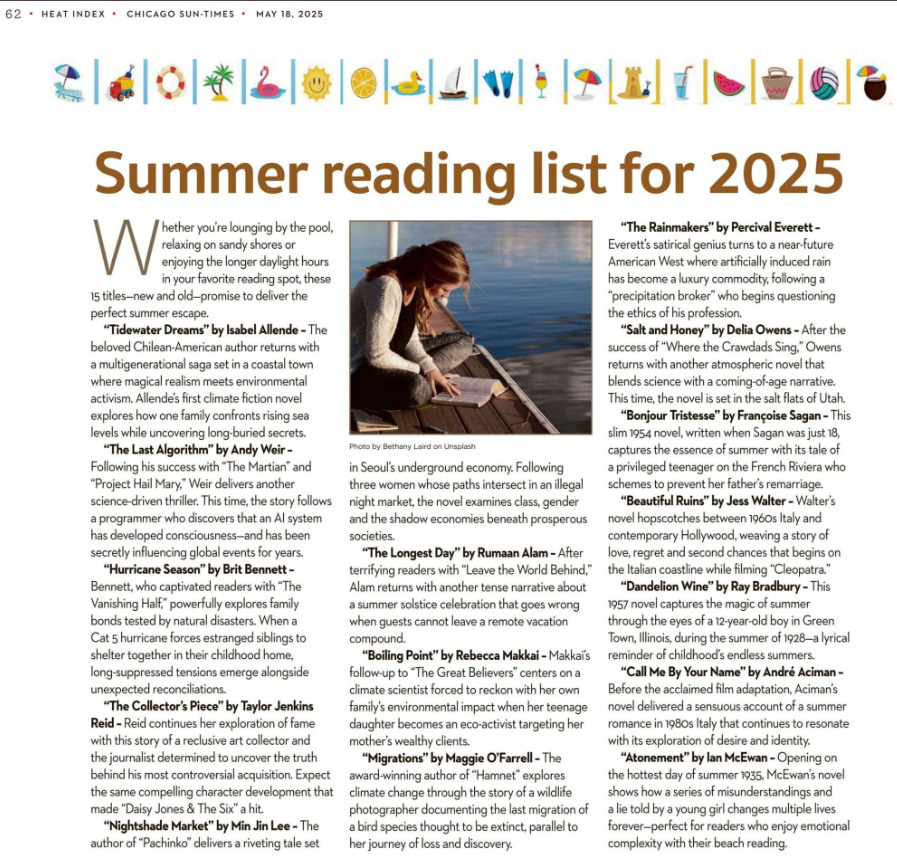
By now you’ve probably seen the A1 steak sauce of a summer reading list published in a special section called “Heat Index,” distributed by the Chicago Sun-Times and the Philadelphia Inquirer. Of the 15 books by prominent authors listed, only 5 of them were real. It was published without a byline but the freelancer responsible for it, Marco Buscaglia, admits he used ChatGPT or Claude to prompt the content and didn’t check the output for accuracy.
Like the large language model machine he used to cut corners, Buscaglia may be incapable of true reasoning, self-awareness, and autonomous goal setting. Or pleasure. People are screaming about this guy in multiple languages, so this is likely an unpopular opinion: I don’t think he’s the real baddie here. I read him as more of an anti-hero.
A thwack in the driveway is barely a thing
When corporations and private equity buy up papers, their profit models force layoffs of the local journalists and photographers who might otherwise produce a robust daily. Syndicated special sections developed by content distributors like King Features, a unit of Hearst Communications, paper over the gaps created by uncertainty and change. Pages of puzzles and comics, seasonal listicles of books the content developer hasn’t read, alongside recipes or products they’ve probably never tried, simulate the look and feel of the news. They’re a simulation of news, designed so that subscribers might not notice how much thinner the paper’s gotten.
A note on intelligence
LLMs have consumed more books than any of us ever could, without enjoying any of them. They do not understand, memorize, or copy faithfully with citations. They do not learn, if by learn we mean “get better at judgement and discerning what is true or false, in ways that are repeatable.” The more powerful they get, the more they hallucinate.
They compress and process, breaking down material to its linguistic patterns, stripped from whatever is unique and original. It’s almost quaint now to read Ted Chiang’s early 2023 analogy, “ChatGPT Is a Blurry JPEG of the Web,” given what we know now about the extent of AI companies’ piracy.
From our books, both the beloved and the despised ones, our web content and the queries humans put into it, the LLMs refine a textual prebiotic soup. This soup concentrates along the shorelines of our most average anxieties, ordinary foibles, and standard cliches. When prompted, the machine gathers strings of this goo and flings them back at the glass.
What took us so long?
It took days for the internet to catch hold of the news Buscaglia’s list was made up, in part because cats and chickens can’t read, and these inserts are most often used to line their boxes. Also, the consistency of this book list closely resembles the stuff of human minds and hearts and fingertips. Like most machine generated text, it carries a whiff of something mineral and doubtful. But the titles and descriptions are entirely plausible as commercial works of fiction, even somewhat relatable to the authors’ existing body of work, and the sentence structure is passable as the work of a college-educated summer intern.
It’s good enough to make a reader question her own expertise, to confirm whether these words came from life by touching glass. And so the feedback loop continues.
Own goal ethics
Buscaglia’s website has since been made private, but when I viewed it Tuesday night it showcased decades of newspaper reporting and editing experience acquired before he turned freelance content developer working for “anyone willing to help [him] pay [his] electric bill.” The site has whole sections focused on his roles as an adjunct first year composition instructor and “career expert” whose copy has been featured on job search websites. And he writes fiction, too. In other words, this is a guy trained to know better than to rely on the giant plagiarism machine, who would seem to have had every reason to care more.
I am no apologist for the “oops, workflow issues!” explanation Buscaglia gave for submitting that output for publication. But I think it’s more bumbling than evil. As a humanist, it's not hard to imagine that, for Buscaglia, generating this blow-in filler content for $.03 a word late at night after working a day job felt like the fictional shithole imagined by base4 had opened up to swallow him whole.
Given the flogging in the public square that comes with this kind of egregious screw up, I hope Buscaglia’s therapist has pointed out the poetic justice in this ironic self-sabotage. Getting caught complying in advance with the automation of his livelihood, handing it over with a Cricut welcome sign and a plate of cookies, is a way out of this survivalist hellscape forever. Buscaglia’s now free to find something worthwhile for a human to do with his time.
When I think of what happened here, one of the strangest stories about sports I’ve ever heard comes to mind. In the mid-90s, Terry Sealy of the Barbados team scored an infamous own goal during a game of the Caribbean Cup. It was intentional, a way to expose the inanity of the ridiculous “double golden goal” rule while unboxing his team from a manufactured disadvantage. Instead of doing the expected thing by making a futile attempt against the clock to win by two and stay in the tournament, Sealy scored an own goal in the last minute to tie things up. This bought the team another 30 minutes of play. He was painted a spiteful villain, but Barbados ended up winning the tournament, leaving the corrupt corporate FIFA bosses no choice but to discontinue that made-up double golden snitch bullshit.
Breaking bad
It kills me to imagine a guy with Buscaglia’s background who couldn’t even spin around in his desk chair and pick some random books off his own shelf to recommend. But the truth is, no one who reads books or has access to the internet needed this anonymous summer reading list. Readers trust booksellers, librarians, their literary friends, Fresh Air, authors and strangers writing about books in the newsletters they follow on Substack, Booktok, Instagram, podcasts– anything but some advertorial. Making that list was an extremely low value task, both in terms of what these content farms pay the “writers” of this kind of stuff as well as its value to anyone else.
Of course the Hearst family, inheritors of billions made through sensationalist yellow journalism, are hardly going to be phased by the little bit of negative press generated for their companies by this debacle. Sure, it’s possible next time they’ll hire a more technically adept person who recognizes the right tool for a job like this is a regular old search engine, not a program designed to make up answers that humans might believe. Of course, part of the reason why content syndicators have incentive to let this kind of thing slide is that eyes (and so, dollars) flowing to legitimate media organizations are getting even tighter as Google’s AI Overview becomes a more dominant aspect of search.
Buscaglia’s more of a Jesse Pinkman to King Features’s Walter White. The real smugglers—OpenAI and Anthropic and Google, and the money behind them—count on us focusing our ire on these low-level cooks. They’ve designed a tool to make stuff up that humans will believe is true. And it worked just like they had planned! It seems to be getting a little better at this all the time! Now we’re all a little more skeptical of the media. Reveling in our mistrust of common people and the media, we reveal our fear that we have become less certain of our ability to discern reality from fakery.
Or worse, we show that we have fooled ourselves into believing that surely if something like this fake book list had shown up in our driveway, or our feed, we would have noticed.
Who’s hallucinating now?

What’s next
I’m not creating a summer reading list, but I’ve decided to commit to reading one new release each month this summer and posting a review during its launch week for you. I’d love your input in deciding which book to review in June. Here’s a quick poll where you can cast your vote between:
Flashlight by Susan Choi, June 3
Lamb by Mr. Troy Ford, June 3
We Don’t Talk About Carol by Kristen L. Berry, June 3
Fox by Joyce Carol Oates, June 17 (excerpt here)
Among Friends by Hal Ebbott, June 24
And also…
I’ve also written about my complicated feelings toward book recommendations lists in general, if you’re curious.
If you liked this post, you may also like:
I’ll leave you with something beautiful. This is Venus Italica, displayed in the Assembly Room of Hearst Castle near Cambria, CA. It was created by sculptor Antonio Canova to replace an ancient greek Venus de Medici statue Napoleon captured from Florence in 1802. Canova was comissioned to make a copy, but he didn’t want to do that. So he invented a new figure to better achieve the illusion of human flesh and capture the vulnerability in the figure’s pose.
Cheers,


Yes to this in your complicated feelings about book lists: it treats books “as though [they] have an expiration date.”
When my book first came out, I was naive. I was genuinely surprised to learn that its PR would have to happen in the first year and then would expire. Because as a reader, I never even considered reading like that! I never paid any attention to when a book was published. I never even thought to notice.
Wow I love everything about this. Reminds me of Culture Study’s piece on how it’s not the workers it’s the jobs. I imagine nobody WANTS to put out crap