Goodreads is Over: A totally biased list of reasons
Beyond the Soylent Green era of literature content
I am a whole person who writes this newsletter about books, but I know of at least one fictional character who has a more transparent book life than I do.
Louise Erdrich appended a seven-page Totally Biased List of Tookie’s favorite books, broken into themed sublists, to The Sentence. As a literary device, the list brings home the book’s faith in readers to develop the collective understanding of history and of human hearts needed to power social progress. And it’s also sublime.
I’ve never made or shared a list of my favorite books because I used to believe this kind of libromancy was an innately private experience. If managed or measured too closely, reading might lose its magic. But now I think it’s more vital than ever for readers to curate their experiences and authentically exchange energy with each other.
In general, I’m pro list. Often my lists improve proportional to the difficulty and import of something I aim to begin. When the desk has been cleared and all the socks in the laundry basket matched but the will to write remains nowhere to be found, for example. Interested in browsing Tookie’s recommendations in the categories of Ghost-Managing, Short Perfect Novels, Books for Banned Love, or Indigenous Lives? You’re welcome!
Before I created this newsletter, I mostly kept my thoughts about books to myself. In the past 26 days I’ve been writing The Booktender I’ve had the most fun setting up personalized reading suggestions threads with paying annual subscribers. It’s enchanting to give and take through the medium of reading lists—and I’m grateful to those of you who trusted me on the basis of the first newsletters, without much window into my reading taste.
I’ve read many books in the past three decades I’ve been an adult. How many? Which ones and which are five stars? I couldn’t tell you because I’ve never tracked my reading that way, online or elsewhere.
If you’ve read my letters, you know I’m not above '90’s nostalgia. One of the irrecoverable conditions that arouses the if only we had known what was coming, it would have ruined the experience feelings I associate most with that era is Amazon circa 1998. Before associations between every imaginable AI-captioned climate-detroying widget drove the algorithms differentiating your Amazon store from mine, there was a brief period where its catalog was limited to books and its recommendation engine fueled by users’ choice to associate with each other.
Word of mouth, but make it extra.
Libraries began adopting WorldCat catalog, with it’s gray block cursor and Helvetica type, but most still maintained card catalogs. Book reviews published in hard copy came weekly or monthly. To live in an intermittent information culture yet be able to browse every book in print in full color glory, while also peeking at shelftalkers shared with you by people you adore; then to stroll downtown in the snow to Atticus Books or the Book Trader Cafe to pick something up because next day shipping exists only for corporate executives for whom time really does equal money. If there’s a heaven this might be it for me.
Of course, Amazon has since become the online shopping site that best exploits the evolutionary preference to stuff ourselves whenever we discover abundance, so as to survive a famine. And paradoxically it’s now been voted Most Likely to Cause Societal Collapse of the kind that would reintroduce famine to the descendants of those of us lucky enough to have lived our whole lives in a reality where influencers discuss without irony intermittent fasting as an intentional practice to manage the cumulative effects of having too much.
One of the best things I read this week was this piece by
in which he writes about the “magical and private and powerful” experience of reading without showing off on the internet:“I love the abstract stew that the books I’ve read gradually combine to create with my own experiences, disappointments, hopes, human encounters, fears, passions. I love that with every new book it gets richer,” he writes.
A watched pot never boils, too many cooks in the kitchen— the proverbs check out.
This put me in mind of a funny story about Goodreads and me. I tried to get on board with it once before 2013. I was an end-stage Blackberry user. Ugly dating ugly never works. Tried again post-Amazon acquisition, in 2017. Reading had fallen frighteningly low on my priority list and I was looking forward to exchanging reviews with high school classmates and Facebook friends from work. The latter included a particular up-and-coming climate change resilience scholar. I’ll probably learn something important from him, I thought.
Like one does when monogamy and early motherhood have you wondering how you could feel so disconnected from your baseline humanity when there’s a literal human attached to your most sensitive parts, I proceeded to download Esther Perel’s Mating in Captivity: Unlocking Erotic Intelligence and The Ethical Slut to an iPad. So slim. So discreet.
Then the emails started. “Goodreads updates from Jen and Bobbi!” with a list of the books they’d started reading. And of course: a subject line including the name of the climate change guy from work. Which meant… was he also right now reading an email telling him what I’d added to my shelf? Mortification. The counting and comparing and taste-influencing available on Goodreads was not enough to motivate me to overshare with innocent bystanders like that.
Goodreads knowledge base confirms that the site does not allow the equivalent of brown paper covers on its shelves. “We don’t offer the ability to make bookshelves private. We started Goodreads to share our reviews with our friends and read theirs.” Fine. But what does that have to do with the fact that it’s possible to delete customized shelves—but not the default shelves of Read, Currently Reading or Want to Read. Which you’ve linked to your Kindle, where we’ll also track your progress and highlights. Assuming we all want to share a play-by-play of our purchases or possible future purchases before we’ve had a chance to open a book, sample it, and decide whether to add it to the life stew or offer it to a well-fed dog named Did Not Finish?
Hunger dystopia à la Soylent Green. But make it more literary.
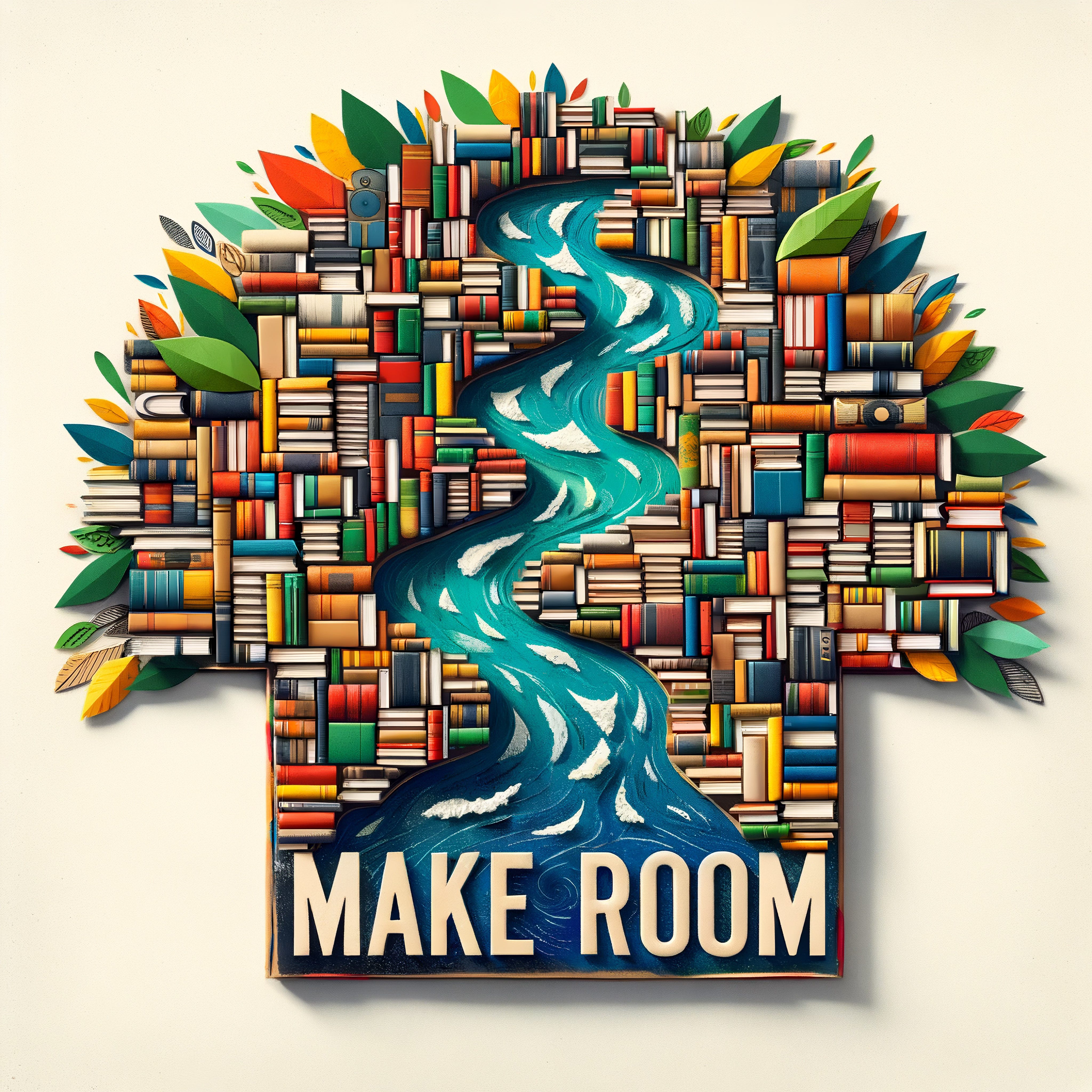
I only recently realized the 1973 movie, set in 2022, is based on the 1966 overpopulation novel Make Room! Make Room! In it the meal replacement product that provides most human nutrition consists of soy and lentils. But overcrowding, mass starvation and a lonely quest to solve a murder by the Andy Rusch/Robert Thorn character were not enough to make the story screenworthy; to do that required the addition of cannibalism.
It’s a case of “Life imitates art far more than art imitates life.” When we’re contributing every atom of our activity to the mass consumption engine, what’s actually in this product they’re feeding us?
I know it’s ironic that I launched this newsletter with a reading provocation hinging on a character who might be pretending to be something they’re not while I myself claim— without significant online evidence— to be someone worth following in relation to your reading life. There are plenty of writers with traditional media chops writing independently about reading on Substack, like
and the folks atAuraist: picking the best-written books of the month and Celine personal canon . I also enjoy a lot of creators who have been self-publishing for their followers consistently for years. I follow , ,, to name a few. And there are a number of thoughtful, academically credentialed guides to the slow reading movement who take readers patiently through tasteful choices. If this sounds intriguing to you, you might want to check out The Beowulf Challenge Personal Canon Formation by John Halbrooks. Close Reads HQ will walk you through The Warden and the Lavransdattar saga and currently hosts a read along of War and Peace.In contrast, I checked because I wasn’t sure if I might have forgotten something but I don’t think there’s even one online recommendation of a book I might have posted prior to starting this newsletter that you could find. So why add my late-blooming, ordinary people voice to the mix?
I created The Booktender because I wondered what might happen if I brought the intuition built from a lifetime of reading together with my curiosity about people. What would it mean to encourage novel associations on a small-to-moderate scale that doesn’t depend on creating an uncurated flood of information or on an algorithm to reflect back to people what it is they like?
I write to support a micro-culture that reads for the personal, idiosyncratic value of literature. I believe these kinds of small and slow opportunities outside the constant stream of information and ranting make it possible to pay more attention and improve the taste of what we consume.
2024 but make it less “riot control.” We can do this.
Up next:
Sunday, January 28 at 4pm MT//6pm ET: Unbooked Session on Zoom. Bring a book.
The February Reading Provocation on a new theme coming out midweek. I will draw a few titles from the Books for Banned Love list and a few others I’m still deciding on. Subscribe and you won’t miss it.
Also planning a guide to authors featured at the Tucson Festival of Books. If you’re giving a reading or talk there and would like to connect to make sure I include you, please let me know!
The offer
I offer all my long form written content freely.
There’s a biweekly gathering that requires more of a two-way exchange. These restorative Unbooked Sessions happen every other Sunday at 4:00 MT. It’s an invitation to unschedule whatever productive activity or end of the weekend angst might have otherwise occupied your spirit to create time for reading in the company of others. Taste makers, slow readers, readers having an anti-algorithm year, readers who keep their personal favorites to themselves, and brown paper covers are all welcome. We read our own book selections and there’s time for brief shelftalk at the end. If you’re already signed up, you can find the Zoom link for this Sunday’s event here.
Substack’s preferred way to exchange energy is in the form of money, specifically automated monthly subscriptions. Subscribing to valuable things on the internet only really work for a few of us whose earnings from the energy we exchange at our jobs make it so we can spend it freely. If you’re also a creator and want to barter upgrades to paid with each other instead, maybe we can work out a trade.
If you’re not a creator, you might prefer to make a one-time contribution of whatever feels comfortable to you to my Ban the Book Bans Fund in lieu of authorizing a regular drain on your balance. Message me a few lines about a memorable book you’ve added to your personal life-sustaining reading recipe when you do and I’d be happy to add you to the list for the next gathering.
If none of that works but you still want to be part of the gathering, drop me a message and I’ll always reply.
If you think you might want to be a regular at the gatherings but aren’t sure, you can sign up for a free 7-day trial. If you know you’re in for an annual subscription you can contribute all at once, you’ll save some money and I’ll also start a thread with you to get to know you so I can share some personalized reading suggestions you might not have discovered yet for your consideration.


Abra, loved reading these reflections (and thank you for the mention as well!)…this sentiment is especially striking: "I write to support a micro-culture that reads for the personal, idiosyncratic value of literature. I believe these kinds of small and slow opportunities outside the constant stream of information and ranting make it possible to pay more attention and improve the taste of what we consume."
This really gets at what I love most about literary conversations on Substack: there's a kind of intimate, idiosyncratic, highly engaging way that people write about literature here, that blends informality and seriousness in a way that's hard to find elsewhere. And it feels intrinsically valuable to create that community, be a part of that community, and use it to nurture one's taste.
Libromancy. I came straight to the comments from there to write it in honour of its newness and innate coolness.
Libromancy.